12 Unforgettable Heist Scenes in Film
From elaborate con jobs to impossible thefts, these sequences defined the genre.
There’s something irresistible about watching a perfectly executed heist unfold on screen. Maybe it’s the meticulous planning, the nail-biting tension, or that sweet moment when everything clicks into place. Or maybe we just love watching clever people do impossible things.
The heist film has given us some of cinema’s most ingenious sequences, where the real thrill isn’t just the theft itself but how our protagonists pull it off. From classic capers to modern masterpieces, these scenes have redefined what it means to steal with style.
Below are twelve heist sequences that prove sometimes crime does pay—at least in entertainment value.
12 Heist Scenes That Will Leave You Breathless
1. Ocean’s Eleven (2001)
Steven Soderbergh’s remake turned the heist film into pure jazz. Danny Ocean (George Clooney) and his crew don’t just rob three Las Vegas casinos simultaneously—they do it with such effortless cool that you’re rooting for them every step of the way.
What makes this heist unforgettable is how the film withholds information from the audience. We see the plan unfold, but Soderbergh keeps pulling back layers, revealing that what we thought we understood was only part of the picture. The moment when we realize the SWAT team storming the vault is actually Ocean’s crew? Chef’s kiss.
The production built a full-scale replica of the Bellagio vault on a soundstage, and the attention to detail shows. Every element—from Basher’s pinch device to Yen folded inside a case—feels both impossibly sophisticated and somehow believable. The scene relies heavily on cross-cutting between multiple locations, with editor Stephen Mirrione creating a rhythm that makes two hours feel like twenty minutes.
I particularly love how the heist itself becomes almost secondary to watching these characters work together. It’s a masterclass in ensemble filmmaking where personality matters as much as the plan.
2. The Italian Job (1969)
“You’re only supposed to blow the bloody doors off!” This line alone cements the film’s legacy, but the heist sequence itself—three Mini Coopers racing through Turin’s streets, sewers, and even a rooftop—is pure cinematic gold.
Director Peter Collinson choreographed the getaway like a ballet, with the tiny cars zipping through spaces that seem physically impossible. The production actually drove Mini Coopers through Turin’s streets and the Lingotto building’s rooftop test track, creating a sequence that still feels fresh decades later.
What sets this heist apart is how it combines careful planning with absolute chaos. The crew creates a massive traffic jam by hacking the city’s traffic control system, then exploits the gridlock to steal gold from an armored car. The Minis become the stars, weaving through the confusion while Quincy Jones’s score propels everything forward.
The cliffhanger ending—literally—has sparked debates for over fifty years. That bus teetering on the edge of a cliff, gold slowly sliding toward the abyss, is the perfect metaphor for every heist: one wrong move and it all falls apart.
3. Heat (1995)
Michael Mann’s bank robbery isn’t just a heist—it’s urban warfare. When Neil McCauley’s (Robert De Niro) crew hits a downtown Los Angeles bank, they’re professional, efficient, and ruthless. But when the cops show up, all that planning goes out the window.
The shootout that follows is arguably the most realistic and intense firefight ever filmed. Mann used live ammunition for the sound recording, and you can feel every bullet. The production shut down entire blocks of downtown LA for the sequence, and the crew rehearsed the choreography for weeks to get the tactical movements right.
What elevates this beyond a typical action scene is Mann’s attention to the aftermath. We watch civilians caught in crossfire, see the crew’s discipline crumble under pressure, and feel the weight of every casualty. The sound design is incredible—each gunshot echoes off buildings, creating a sonic landscape that makes you flinch.
I’ve watched this sequence dozens of times, and it never loses its impact. The way Mann shoots it—no music, just the raw sound of automatic weapons and breaking glass—makes you feel like you’re trapped on that street corner with everyone else.
4. Rififi (1955)
Jules Dassin’s thirty-minute jewel heist sequence remains the gold standard for cinematic theft. Not a single word of dialogue, no music—just pure tension as four men break into a Parisian jewelry store.
The crew has to bypass an alarm system connected to the floor and ceiling, so they work from above, carefully drilling through the ceiling while muffling the sound. Dassin shoots it in real time, forcing us to sit with every agonizing moment of uncertainty. Every creak, every dropped tool feels like a disaster waiting to happen.
What’s remarkable is how Dassin makes technical problem-solving absolutely riveting. We watch them use an umbrella to catch falling debris, employ foam to muffle the sound of breaking glass, and work with surgical precision around the alarm system. The cinematography, shot by Philippe Agostini, uses shadows and close-ups to create almost unbearable claustrophobia.
This sequence influenced virtually every heist film that came after it. Dassin proved you didn’t need explosions or chases—sometimes the quietest moments are the most thrilling.
5. The Dark Knight (2008)
“I believe whatever doesn’t kill you simply makes you… stranger.” The opening bank heist of The Dark Knight isn’t just a robbery—it’s our introduction to true chaos.
Christopher Nolan shoots the sequence like a classical heist film, with multiple crew members executing a coordinated bank job. But then Nolan pulls the rug out: the Joker (Heath Ledger) has orchestrated it so each crew member kills another, until only he remains to collect the money. It’s brutal efficiency disguised as anarchy.
The production filmed at the old Chicago Post Office building, and the practical effects—particularly that school bus crashing through the bank wall and seamlessly joining a line of other school buses—required precise timing and actual stunt coordination. No CGI trickery, just perfect execution.
What makes this heist memorable isn’t the technical aspects but what it reveals about the Joker. This isn’t about money—it’s about making a statement. The way he removes his mask to reveal clown makeup underneath tells you everything: this is someone for whom crime itself is performance art.
6. Inception (2010)
Technically, they’re stealing an idea rather than planting one (or are they?), but the heist at the film’s climax operates on four simultaneous dream levels, each with different time scales and physics.
Christopher Nolan’s greatest achievement here is making the impossible comprehensible. We track Arthur (Joseph Gordon-Levitt) fighting in a rotating hotel corridor, Eames (Tom Hardy) providing cover in a snowy fortress, and Cobb (Leonardo DiCaprio) confronting his subconscious in limbo—all happening simultaneously but at different speeds.
The rotating corridor fight is a practical effect masterpiece. Production designer Guy Hendrix Dyas built a rotating hallway gimbal that could spin 360 degrees, and Gordon-Levitt performed most of his own stunts inside it. The result is one of the most disorienting and innovative action sequences ever filmed.
What I love most is how the heist structure forces us to keep multiple timelines in our head simultaneously. It’s not just entertaining—it’s mentally exhausting in the best way possible. The final kick, with vehicles falling and gravity shifting across dream levels, is pure cinematic adrenaline.
7. The Town (2010)
Ben Affleck’s Boston bank robbery opens with a sequence that feels terrifyingly real. The crew, wearing skull masks, moves with military precision through a Cambridge bank, controlling hostages with practiced efficiency.
What sets this apart is the authenticity. Affleck researched actual Charlestown robberies and consulted with former bank robbers to get the details right. The crew’s movements, their communication, even the way they handle weapons—it all feels lived-in and professional. These aren’t movie criminals; they’re working-class guys who treat robbery like a blue-collar job.
The getaway through Boston’s narrow streets, with cops closing in from every angle, showcases Affleck’s skill as a director. He shot on location in Charlestown, using the neighborhood’s tight corners and dead ends to create genuine claustrophobia. The sequence culminates with the crew dumping their getaway car and bleaching it to destroy evidence—a detail pulled from real robbery cases.
The visceral quality of the violence, the way Claire (Rebecca Hall) experiences trauma from being taken hostage, the professional coldness with which Doug (Affleck) executes the job—it all adds up to a heist that feels less like entertainment and more like documentary.
8. Mission: Impossible (1996)
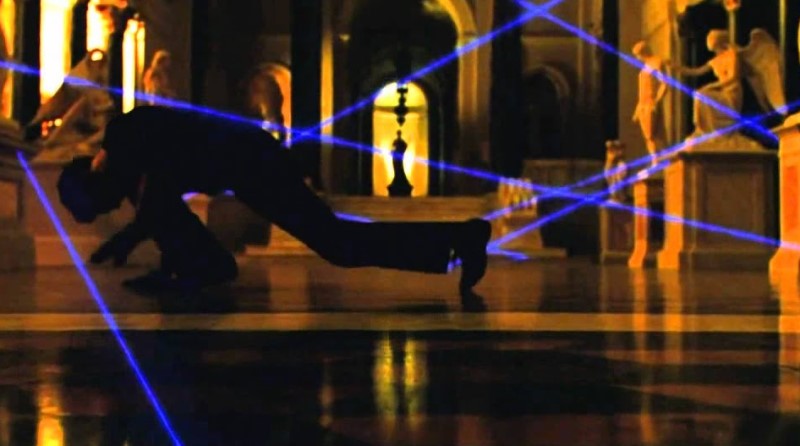
The CIA vault break-in is heist filmmaking at its most suspenseful. Ethan Hunt (Tom Cruise) must steal the NOC list from a temperature-sensitive, sound-sensitive, and pressure-sensitive room. One wrong move—a bead of sweat, a rat, a dropped knife—and alarms scream.
Brian De Palma directs this sequence with Hitchcockian precision. The camera work is meticulous, showing us exactly how precarious everything is. Hunt is suspended from the ceiling by a wire, unable to touch the floor, barely breathing, while Krieger monitors from above. De Palma holds on these moments, letting tension build naturally rather than rushing through the mechanics.
The practical effects work here is exceptional. Cruise actually performed the wire suspension stunt, hanging upside down for extended takes. The production built the vault set with functioning temperature and pressure sensors, making the environment feel genuinely dangerous even though we know it’s not.
That moment when the rat appears, crawling toward Hunt’s face while he hangs helplessly—it’s such a simple element but it amplifies the tension tenfold. And the knife drop, caught inches from the floor, still makes audiences gasp twenty-five years later.
9. Inside Man (2006)
Spike Lee’s bank robbery plays like a chess match, with detective Frazier (Denzel Washington) trying to outthink Dalton Russell (Clive Owen), who’s orchestrated the perfect heist disguised as a hostage situation.
What makes this heist brilliant is its simplicity. Russell and his crew take over a Manhattan bank, put everyone in identical costumes to hide among the hostages, and create chaos to mask their true objective. Lee shoots the sequence with clinical precision, using split screens and time jumps to disorient us just as the police are disoriented.
The reveal—that Russell has been hiding inside the bank the entire time, waiting out the investigation in a custom-built room—is so elegantly simple you kick yourself for not seeing it coming. Lee and screenwriter Russell Gewirtz play fair with the audience, giving us all the clues while misdirecting our attention.
The production filmed at the actual Manhattan Trust Company building, giving the sequence an authentic New York feel. Lee’s use of wide angles and deep focus lets us scan the frame for details, turning the audience into detectives alongside Frazier.
10. Reservoir Dogs (1992)
We never actually see the diamond heist in Quentin Tarantino’s debut, but that’s what makes it genius. Instead, we see the aftermath—the paranoia, the blood, the realization that someone betrayed them.
The brilliance is in the structure. Tarantino fragments the timeline, showing us the planning, the escape, and the warehouse standoff, but never the crime itself. It’s a heist film that’s entirely about consequences rather than execution. The real heist is Tarantino stealing every convention of the genre and reassembling them into something entirely new.
What we do see is Mr. Orange (Tim Roth) bleeding out in the warehouse while the crew falls apart around him. Michael Madsen’s Mr. Blonde torturing a cop to “Stuck in the Middle with You” is more memorable than any safe-cracking or vault-breaking could ever be. Tarantino makes the violence matter by making it personal and uncomfortable.
The low-budget production shows everywhere, but that grittiness works. Shot in an actual abandoned warehouse, with minimal lighting and handheld cameras, the film feels dangerous and unpredictable. Tarantino proved you don’t need elaborate set pieces—sometimes the best heist is the one that happens off-screen.
11. The Sting (1973)
George Roy Hill’s Depression-era con isn’t a traditional heist—it’s an elaborate confidence game where the real crime is convincing the mark he’s committing one. Johnny Hooker (Robert Redford) and Henry Gondorff (Paul Newman) create a fake betting parlor to swindle crime boss Doyle Lonnegan (Robert Shaw).
The beauty of this sequence is how many layers it has. We’re watching Hooker and Gondorff set up their con, but Hill is conning us too. The FBI raid that seemingly ruins everything? Part of the con. The shooting that appears to kill Gondorff? Fake. By the end, you’re not sure what was real and what was performance.
Hill structures the film in chapters, announcing each phase of the con like title cards in a silent movie. This theatrical approach, combined with Marvin Hamlisch’s ragtime score, gives everything a playful, almost nostalgic quality. The production design by Henry Bumstead recreates 1930s Chicago with meticulous attention to period detail.
What I love most is how the film respects its audience. Hill doesn’t spoon-feed us the con—we have to work to follow the layers of deception, which makes the payoff that much sweeter when everything clicks into place.
12. Baby Driver (2017)
Edgar Wright choreographs his opening bank robbery getaway to “Bellbottoms” by The Jon Spencer Blues Explosion, and the result is pure kinetic cinema. Baby (Ansel Elgort) waits outside while the crew robs a bank, then leads police on a chase through Atlanta that’s timed perfectly to the music.
Wright’s innovation is treating the heist like a musical number. Every screech, every gunshot, every shift of the gear aligns with the beat. The production used a combination of practical stunts and minimal CGI to achieve the sequence, with stunt coordinator Robert Nagle choreographing the driving to match the pre-recorded music playing on set.
Baby weaving through traffic, using mall parking lots and back alleys, feels less like evasion and more like dance. Wright mounts cameras inside and outside the car, using long takes and whip pans to keep us locked into Baby’s perspective. The sound design—mixing the diegetic music from Baby’s earbuds with the actual sounds of the chase—creates an immersive experience unlike anything else.
This isn’t the most complex heist on the list, but it might be the most purely entertaining. Wright proves that style and substance aren’t mutually exclusive—sometimes style is the substance.
Summing Up
From the silent tension of Rififi to the musical precision of Baby Driver, these heist scenes represent the full range of what cinema can achieve when clever characters attempt impossible crimes. Whether it’s the meticulous planning, the unexpected twists, or the sheer audacity of the theft itself, these sequences stay with us long after the credits roll.
How many of these heists have you watched? Which one would you most want to be part of? Did we miss your favorite heist sequence? Let us know in the comments below—and remember, discussing movie heists is perfectly legal.
Catch us for latest Bollywood News, Movies Reviews, New Movie Release , and Follow us on Instagram, Twitter, Facebook