
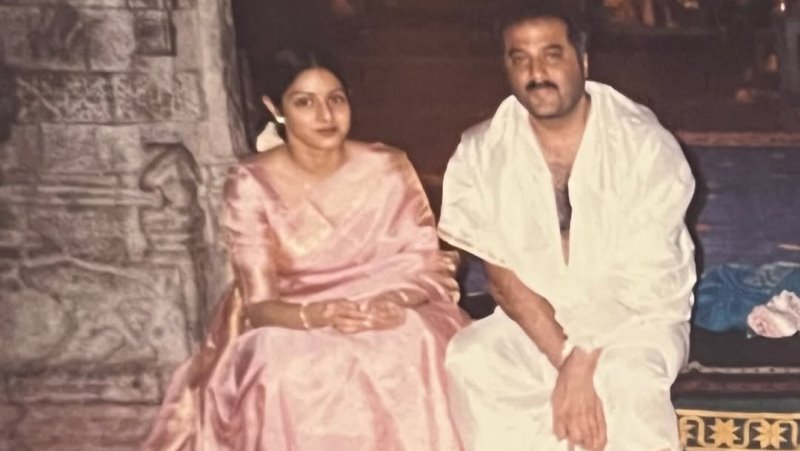
The Fight Over Sridevi’s Chennai Farmhouse — A 38-Year-Old Land Deal, a Disputed Marriage & a Family’s Last Memory
Boney Kapoor, Janhvi, and Khushi are battling strangers in court over a coastal property bought in 1988. But this case is about far more than just land.
There’s something painfully poetic about the fact that the very property Sridevi bought as a getaway — a breezy farmhouse off Chennai’s East Coast Road, steps from the sea — is now at the center of a legal storm. Years after the legendary actress passed away, her family finds themselves defending that 4.7-acre patch of land in a courthouse, not a film set. And the opponents? A woman who claims a long-dead man was her husband, and two sons who say the whole 1988 purchase was built on fraud.
The Property: What Exactly Is at Stake?
The land in question is situated on the East Coast Road (ECR) in Chennai — one of the most scenic and rapidly appreciating coastal stretches in South India. Sridevi purchased the property on April 19, 1988, from a man named M.C. Sambanda Mudaliar. The deal was done through registered sale deeds, all legal formalities were completed, and the Kapoor family has been in continuous possession of the land for nearly four decades since.
Today, the land functions as a farmhouse retreat — a quiet, private sanctuary that holds enormous sentimental value for Boney Kapoor and his daughters. For Janhvi and Khushi, it is one of the last tangible connections to their mother. The property is estimated to be worth approximately ₹20 crore, though its emotional value to the Kapoor family is clearly beyond any price.
Case at a Glance
- Property4.77 acres on East Coast Road (ECR), Chennai
- PurchasedApril 19, 1988 — by Sridevi from M.C. Sambanda Mudaliar
- Est. Value~₹20 Crore
- ClaimantsChandrabanu, M.C. Sivakami & M.C. Natarajan
- Kapoor’s PleaMadras High Court, filed March 16, 2026
- Next HearingMarch 26, 2026
- Current StatusTrial court proceedings stayed by HC
Who Are the Claimants — and What Do They Want?
The civil suit was filed by three individuals: a woman named Chandrabanu and her two children, M.C. Sivakami and M.C. Natarajan. Their claim goes back to the original owner of the land, M.C. Sambanda Mudaliar. In February 1960, Mudaliar had divided his property among family members through a mutual agreement — three sons and two daughters getting their respective shares.
Chandrabanu claims to be the second wife of one of Mudaliar’s sons, a man named Chandrasekaran. She says she married him in 1975. Based on that claimed marriage, she and her children assert that they have a rightful share in the land and that the sale deeds executed in favour of Sridevi in 1988 were fraudulent and must be declared null and void.
It is a bold claim. And the Kapoor family has not taken it lying down.
Boney Kapoor Fights Back: The Family’s Counter-Arguments
The Kapoor family’s legal pushback rests on multiple solid pillars. First and most obviously — the question of time. The original sale deeds are from 1988. The civil suit was filed in 2025. That is a gap of 37 years. Boney Kapoor’s legal team argued before the court that such a suit is barred by limitation — meaning the law itself doesn’t allow a challenge this late, especially without any justification for the extraordinary delay.
Then there’s the question of Chandrasekaran — the man Chandrabanu claims to have married. He passed away on May 29, 1995. During his entire lifetime, Chandrasekaran never raised any objection to Sridevi’s purchase or the 1988 sale deeds. Not once. If the transaction was truly fraudulent, it raises an obvious question: why did the man who allegedly had the most to lose stay completely silent about it until his death?
Beyond that, the Kapoor family directly challenged the legitimacy of the second marriage itself. Chandrabanu says she married Chandrasekaran in 1975. But Boney Kapoor argued in court that Chandrasekaran’s first wife was still very much alive at that time. Under Indian law, a second marriage while the first spouse is living is legally invalid — which would mean Chandrabanu’s marriage has no legal standing, and neither do the inheritance claims derived from it.
Finally, the family pointed out that even Sivakami and Natarajan — the two children — had reached adulthood long ago. Sivakami came of age in 1995, Natarajan in 1999. They had years, even decades, to raise a legal challenge. They chose not to. Filing a suit in 2025 raises serious questions about the motivation and timing of these claims.
The Heirship Certificate Controversy
This legal battle actually has a prequel. In August 2025, Boney Kapoor had already knocked on the Madras High Court’s doors over a separate but related issue — a legal heirship certificate that the three claimants had managed to obtain. Kapoor alleged that the certificate was fraudulently procured and was being used by the trio to file cases and create unnecessary hurdles around the family’s rightful ownership.
Justice N. Anand Venkatesh heard that plea and directed the Tambaram Taluk Tahsildar to review and decide on Kapoor’s request to cancel the disputed certificate within four weeks. The fact that a court-issued certificate existed — even a potentially questionable one — gave the claimants just enough legal ammunition to file their civil suit afterward. That suit is what is now being contested in the Madras High Court.
How the Case Reached the High Court
After the heirship certificate episode, the claimants filed a civil suit before the Additional District Court in Chengalpattu, seeking to have the 1988 sale deeds cancelled. Boney Kapoor, Janhvi, and Khushi responded by filing an application in the same court — requesting that the suit be dismissed upfront, without going to a full trial.
Their argument was straightforward: the claims are legally unsustainable on the face of it, and there is no reason to drag the family through an elaborate trial. However, the Chengalpattu court disagreed. It ruled that the dispute involves questions of title and ownership that need detailed examination, and allowed the suit to proceed to trial.
That decision is what brought the Kapoor family to the Madras High Court. On March 16, 2026, they filed a civil revision petition challenging the lower court’s order. Justice T.V. Thamilselvi took up the matter and scheduled it for final hearing on March 26, 2026. Until then, she ordered a temporary stay on all proceedings in the lower court — giving the Kapoor family at least a brief pause in what has been a draining legal ordeal.
Why March 26 Matters
The upcoming hearing is a genuine fork in the road. If the Madras High Court agrees with the Kapoor family and dismisses the civil suit at this stage, it would be a decisive win — sparing the family from a potentially years-long trial. It would also send a clear message that challenges to old property transactions, especially ones filed after several decades of silence, face a very high legal bar.
If the court decides the suit should proceed to full trial, it opens the door to a lengthy legal process that would require both sides to present detailed evidence — including documentation from 1960, 1975, 1988, and beyond. The Kapoor family’s legal team would then need to prove, in painstaking detail, that the claimants have no standing whatsoever.
Either way, the March 26 hearing will set the tone for everything that follows.
A Bigger Picture: Why Legacy Property Disputes Keep Happening
The Kapoor-Sridevi case is not an isolated incident. Across India, older property transactions — particularly ones from the 1980s and earlier, when documentation standards were less rigorous — are increasingly being challenged. As land values have soared, especially on prime stretches like Chennai’s ECR, the financial incentive to contest old deals has grown enormously.
Courts often face a dilemma in such cases. Trial courts tend to lean toward allowing full hearings whenever title questions arise, precisely because they don’t want to shut down legitimate claims prematurely. Higher courts, on the other hand, are more willing to step in when a case appears legally untenable from the start — particularly when it involves extraordinary delays.
The Kapoor case has elements of both: genuine questions about the claimants’ legal standing, but also real documentation that exists — a heirship certificate, a civil suit, court proceedings. Untangling it requires exactly the kind of judicial patience and scrutiny that the Madras High Court is now called upon to apply.
More Than Just a Legal Battle
Step back from the legalese for a moment, and what you see is a family trying to hold on to something irreplaceable. Sridevi died in February 2018. She was 54. Her passing left a void in Indian cinema — and a far more personal one in the lives of Boney, Janhvi, and Khushi. The Chennai farmhouse isn’t just land. It’s a place where memories were made, where the family retreated from the relentless glare of fame, where the sea breeze carried something of Sridevi herself.
Janhvi and Khushi, both now finding their own footing in the film industry, are fighting for more than square footage. And Boney Kapoor — a man who has spoken often and emotionally about missing his wife — is fighting for a piece of the world that still feels like her.
That is the quiet heart of this story, beneath all the court filings and legal jargon. A family’s grief, their inheritance, and the memory of one of the greatest actresses India has ever seen — all riding on a hearing scheduled for March 26, 2026.
Catch us for latest Bollywood News, Movies Reviews, New Movie Release , and Follow us on Instagram, Twitter, Facebook