
Wait – A Birthday Greeting Became India’s First Global Virus?
Imagine booting up your computer on a quiet January morning in 1991 — and suddenly, your screen freezes. No warning. No error code. Just a demand: TYPE HAPPY BIRTHDAY JOSHI.
That was the bizarre reality for thousands of computer users across India, parts of Europe, the UK, and even Africa in the early 1990s. And now, over three decades later, that strange, whimsical moment from tech history is about to get its cinematic close-up — courtesy of Bollywood powerhouse Ajay Devgn.
His upcoming project Happy Birthday Joshi is already turning heads before a single frame has been officially screened. Here’s why this might just be the most unexpectedly fascinating film announcement of 2026.
What Is “Happy Birthday Joshi”? The Official Announcement Breakdown
The announcement dropped on Ajay Devgn’s verified Instagram account (@ajaydevgn), and the internet collectively did a double take.
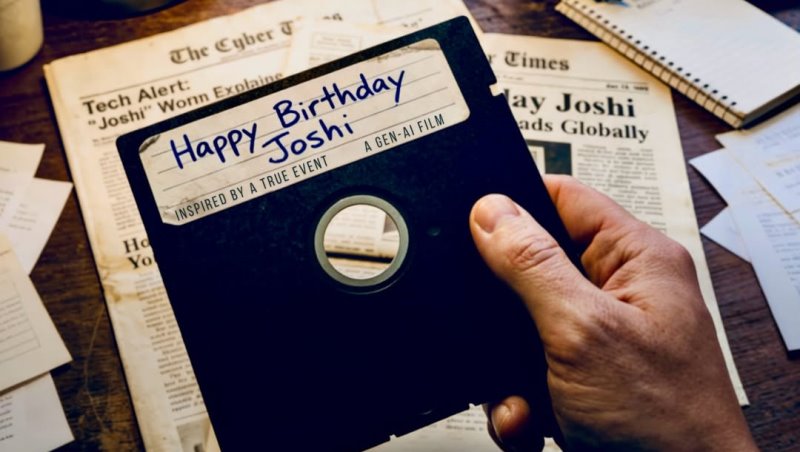
The poster is striking in its retro minimalism: a hand holds a black 5.25-inch floppy disk — the kind that belonged to a pre-Windows, pre-internet world — labeled simply, “Happy Birthday Joshi – A Gen-AI Film.” Around it, scattered newspapers, a typewriter, stained coffee mug, and flickering desk lamp paint a picture straight out of a 90s newsroom.
View this post on Instagram
And then there’s the tagline, sitting right at the centre of everything:
“Everyone has a breaking point. His just went global.”
Here are the confirmed production details from the poster:
- Produced by: Ajay Devgn & Danish Devgn
- Directed by: Anshul Kumar Sharma
- Written by: Vatsal Sheth
- Creative Producer: Sahil Nayar
- Production: Lens Vault Studios, in association with Havas Play & Prismix Studios
- Release Date: 2nd April 2026
- Format: Gen-AI Film — Inspired By A True Event
April 2nd, by the way, is Ajay Devgn’s birthday. That’s not a coincidence — it’s a wink.
The True Story Behind the Film: India’s First Global Computer Virus
To understand why this film matters, you need to go back to 1990 — before broadband, before smartphones, before the concept of “going viral” even existed as a phrase.
A Floppy Disk. A Birthday. A Worldwide Outbreak.
Somewhere in India — most likely Mumbai, Pune, or Gujarat, though no one has ever confirmed it — a programmer wrote a small piece of code. It was a boot sector virus, meaning it embedded itself into the very first instructions a computer reads when it starts up. Nobody knew his real name. Nobody knows it still. But his creation would carry a name the world would remember: the Joshi Virus.
First formally isolated in June 1990, the Joshi virus was unlike most of its contemporaries. It didn’t corrupt files. It didn’t wipe hard drives. It didn’t steal anything. Instead, once a year — every January 5th — it would simply halt your computer and demand you type the phrase: “HAPPY BIRTHDAY JOSHI.”
Type it correctly, and your machine would boot normally, as if nothing had happened. Refuse, or type it wrong, and you were stuck — frozen in digital limbo until you played along with a stranger’s birthday wish.
How It Spread Across the World — One Floppy at a Time
In 1990, there was no email attachment to click, no malicious download link. The only way software traveled was physically — on 5.25-inch floppy disks passed hand to hand, shared between offices, carried in briefcases across borders.
That’s exactly how Joshi traveled. Disk by disk, boot sector by boot sector, it quietly hitched rides across continents. By the early 1990s, it had been reported in the United Kingdom, parts of Europe, and Africa — an astonishing reach for a piece of code that never touched the internet.
There was also a technical quirk that made Joshi oddly noticeable: on floppy disks, it quietly formatted a hidden extra track at the very end to store itself. This caused floppy drives to produce a distinctive clicking or grinding noise — the sound of a secret being written, though no one knew it at the time.
Why “Joshi” Became a Legend in Cyber History
Most viruses from that era were destructive — created to damage, to demonstrate power, or to cause chaos. Joshi was almost the opposite. It was polite, in its own bizarre way. It asked nicely. It waited patiently. And once you complied, it let you go.
That combination of global reach and harmless intent made it one of the most memorable pieces of early malware ever documented — and the distinction of being widely regarded as India’s first computer virus to gain international notoriety cemented its place in the unofficial hall of fame of tech history.
So What’s the Film Actually About? Breaking Down the Concept
The poster tells us the film is “inspired by a true event” — and the floppy disk, the 90s newsroom aesthetic, and the tagline all point clearly toward this very story.
But Happy Birthday Joshi isn’t likely a documentary. The language around it — “breaking point,” “went global,” the theatrical Gen-AI format — suggests something far more interesting: a dramatic or satirical reimagining of what might have happened behind the scenes.
Think about it from the creator’s perspective. Someone, somewhere, wrote a small piece of code as what was probably a personal tribute — a birthday message for a friend, a colleague, maybe even themselves. They had no idea it would replicate itself across continents, end up on front pages, get written about in international tech publications, and become a cautionary tale taught in early cybersecurity circles.
That’s the story here. An ordinary person’s ordinary impulse — a birthday greeting — accidentally becoming a global phenomenon. The tagline isn’t just clever marketing; it’s the emotional core of the entire film.
In tone, the project reads like it could land anywhere between a sharp thriller, a comedy of errors, or a poignant meditation on unintended consequences. The retro visuals lean nostalgic; the Gen-AI production method leans aggressively modern. That tension — old world meets new — might be precisely the point.
What Makes This a “Gen-AI Film” — And Why That’s a Big Deal
The poster explicitly labels this a Gen-AI film — making it one of the first mainstream Indian productions to openly carry that tag as a creative identity, not just a behind-the-scenes footnote.
This is significant for a few reasons.
First, it signals that Generative AI isn’t being used here as a gimmick or a cost-cutting shortcut — it’s being presented as a legitimate filmmaking tool, worthy of front-of-poster billing. That’s a bold creative statement in an industry still figuring out where AI belongs.
Second, there’s a delicious meta-irony at play. A film about an early piece of code that went viral — being made using the most advanced generative code of the current era. The Joshi virus was, at its heart, a program that replicated and spread beyond its creator’s control. Generative AI is, at its heart, a system trained on patterns it was never directly programmed with. Both represent technology doing something unexpected, something its creator may not have fully anticipated.
Whether intentional or not, that parallel gives Happy Birthday Joshi a conceptual depth that most film announcements simply don’t have.
Ajay Devgn as Producer: A Surprising But Smart Move
Ajay Devgn producing a Gen-AI short film about a 1990s computer virus might sound like the setup to a joke — but it’s actually a very calculated creative risk.
Devgn has spent decades building a reputation as one of Bollywood’s most commercially savvy and creatively diverse players. From Gangaajal to Drishyam to Tanhaji, his production choices tend to reflect a genuine curiosity about untold Indian stories — particularly ones that sit at the intersection of history, identity, and consequence.
Happy Birthday Joshi fits neatly into that lineage. It’s a story most Indians have never heard, about a moment in tech history that belongs entirely to this country. Bringing it to screen — especially through the lens of new technology — feels less like a vanity project and more like genuine creative ambition.
Releasing it on his own birthday? That’s just good showmanship.
Why This Story Feels So Relevant Right Now
We live in an age where things go viral before their creators even understand what they’ve made. A tweet, a meme, a video — one moment it’s nothing, the next it’s everywhere, reshaping conversations, derailing careers, or accidentally sparking movements.
The creator of the Joshi virus experienced the 1990 version of exactly that. In a pre-internet world, his tiny piece of code managed to do what most viral content today struggles to achieve with every algorithmic advantage available: it genuinely spread across the world, organically, on the strength of nothing but human-to-human contact.
That story — of unintended reach, of a small personal act becoming a global conversation — has never been more relevant. And the fact that it’s being told through Gen-AI filmmaking, itself a technology whose reach and consequences we’re still figuring out, gives it a mirror-like quality that feels almost too perfectly timed.
The Verdict: Should You Be Excited?
Absolutely.
Even setting aside the novelty of the Gen-AI format, Happy Birthday Joshi is built on genuinely compelling source material. It’s a true story that most people don’t know, told from a human angle that most tech stories forget to include. It has nostalgia, irony, historical weight, and a tagline that actually means something.
Whether it lands as a short film, a digital series, or something else entirely, this project has the ingredients to be one of the more memorable pieces of Indian digital content in recent memory — not because of its budget or its star power, but because its core idea is genuinely fascinating.
Somewhere out there, the real “Joshi” — or whoever typed that code in 1990 — probably has no idea what’s about to happen to their story. Which, when you think about it, is exactly how this whole thing started.
Quick Facts: Happy Birthday Joshi At a Glance
| Film Title | Happy Birthday Joshi |
| Type | Gen-AI Film |
| Inspired By | The Joshi Virus (1990) — India’s first global computer virus |
| Producer | Ajay Devgn, Danish Devgn |
| Director | Anshul Kumar Sharma |
| Writer | Vatsal Sheth |
| Production House | Lens Vault Studios / Havas Play / Prismix Studios |
| Release Date | 2nd April 2026 |
| Tagline | “Everyone has a breaking point. His just went global.” |
Stay tuned to this space for trailers, cast reveals, and all updates on Happy Birthday Joshi as the April 2nd release approaches.
Catch us for latest Bollywood News, Movies Reviews, New Movie Release , and Follow us on Instagram, Twitter, Facebook