
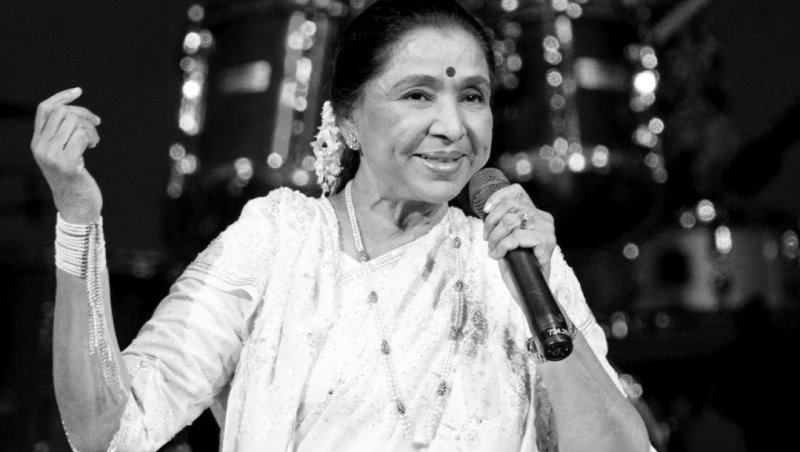
Asha Bhosle: The Voice That Sang India to Sleep – and Woke It Up Dancing
From a 10-year-old girl singing to feed her family, to a 92-year-old legend who recorded over 12,000 songs across seven decades — the extraordinary life and eternal legacy of Bollywood’s most versatile voice.
Asha Bhosle — the voice of a generation, and of every generation that followed.
On the morning of April 12, 2026, India lost its most enduring voice. Asha Bhosle — playback singer, cultural institution, and living proof that art has no expiry date — passed away at Mumbai’s Breach Candy Hospital at the age of 92. She had been admitted just the previous evening, and yet the news still arrived like a sudden silence in the middle of a song that had been playing your entire life.
She recorded over 12,000 songs. She sang in more than 20 languages. She worked with every major composer of the 20th century, survived personal heartbreak that would have crushed most people, and somehow kept singing. Right up until 2026, she was still lending her voice to new music. That’s not a career — that’s a calling.
- BornSeptember 8, 1933 — Sangli, Maharashtra
- DiedApril 12, 2026 — Mumbai, age 92
- Songs recordedOver 12,000 across 7 decades
- Languages20+ including Hindi, Bengali, Marathi, Urdu
- AwardsFilmfare (7×), Dadasaheb Phalke, Grammy nominations (2×)
- Final recording“The Shadowy Light” — Gorillaz, 2026
A Girl Who Had No Choice But to Sing
Asha Mangeshkar was born on September 8, 1933, into a musical family in Sangli, a small town in what is now Maharashtra. Her father, Pandit Deenanath Mangeshkar, was a Marathi classical singer and theatre actor of considerable reputation. Music wasn’t something the Mangeshkar children were encouraged to pursue — it was simply the air they breathed.
When Deenanath passed away in 1942, Asha was just nine years old. Her elder sister Lata, already showing signs of the extraordinary talent that would make her one of India’s most beloved voices, stepped up as the family’s musical breadwinner. Asha followed. They moved to Bombay, and what began as survival quickly became destiny.
Eloping at Sixteen, Rising at Twenty
At 16, against her family’s wishes, Asha eloped with Ganpatrao Bhosle, her personal secretary who was 15 years her senior. The marriage was tumultuous — she was mistreated by her in-laws, separated from her family, and left to raise children largely on her own when the marriage collapsed in 1960. She took his surname, kept it for the rest of her life, and made it one of the most famous names in Indian music history.
In those difficult early years, Asha couldn’t be selective about the songs she took on. While her sister Lata was the first choice of most directors and composers, Asha accepted what came her way — cabaret numbers, vamp songs, film genres that were considered less prestigious. It turned out to be the best accident of her career.
The Sound That Defined a Generation
By the mid-1960s, Asha Bhosle had found her greatest musical partner: R.D. Burman, known affectionately as Pancham. The son of legendary composer Sachin Dev Burman, Pancham was recklessly experimental — he brought jazz rhythms, rock guitar, and Latin percussion into Hindi film music at a time when Bollywood was still largely classical in sensibility. Asha didn’t just keep up with him; she thrived.
Together, they created the soundtrack of an era. Songs from films like Teesri Manzil, Caravan, Hare Rama Hare Krishna, and Sholay weren’t just hits — they became cultural anchors. When you hear Dum Maro Dum or Piya Tu Ab To Aaja, you don’t just hear a song. You hear 1970s India: its youth, its restlessness, its hunger for modernity.
The two fell in love off-screen as well, and married in 1980 — a relationship that faced resistance from Pancham’s family but endured until his death in 1994. It was a loss from which those who knew her said she never fully recovered. But she kept singing.
Versatility Was Her Superpower
What set Asha Bhosle apart from nearly every other singer of her era wasn’t just the quality of her voice — it was her extraordinary range of expression. She could purr seductively in a cabaret number and then, in the very next session, render a devotional bhajan with absolute sincerity. She sang ghazals with the delicacy of a classical musician, folk songs with earthy warmth, and pop numbers with the energy of someone half her age.
She sang in Hindi, Bengali, Marathi, Punjabi, Tamil, Telugu, Kannada, Gujarati, Urdu, and over a dozen other languages. She sang for films, for albums, for concerts across the world. She even sang for a Pakistani film in 2006, recording “Dil Key Taar Bajey” with pop singer Jawad Ahmed — a song that became a cross-border hit at a time when such collaborations were rare and meaningful.
- Dum Maro DumHare Rama Hare Krishna (1971)
- Piya Tu Ab To AajaCaravan (1971)
- O Haseena ZulfonwaliTeesri Manzil (1966)
- Chura Liya Hai TumneYaadon Ki Baaraat (1973)
- In Aankhon Ki MastiUmrao Jaan (1981)
- Mera Kuch SaamanIjaazat (1987)
When the World Came to Listen
Asha Bhosle’s reach was never limited to India. The British band Cornershop released “Brimful of Asha” in 1997, a tribute to her that became a UK chart phenomenon — particularly after Fatboy Slim’s remix sent it to number one in 1998. The song introduced an entire generation of Western listeners to her name.
In 2002, she collaborated with R.E.M.’s Michael Stipe on “The Way You Dream,” recorded for the ambitious 1 Giant Leap world music project. In 2005, the Kronos Quartet recruited her for their album celebrating R.D. Burman’s film music — a collaboration that introduced her to audiences in classical concert halls from San Francisco to London. That same year, The Black Eyed Peas sampled her recordings on their global hit “Don’t Phunk With My Heart.”
And in 2026, just months before her death, she recorded a track with Gorillaz for their album The Mountain. The virtual British band and a 92-year-old Bollywood legend — and somehow, it made perfect sense.
More Than a Singer
In her later years, Asha Bhosle channelled her energy into ventures beyond music. She launched a chain of Indian restaurants called Asha’s, starting with a location in Dubai in 2002 and expanding into the United Kingdom. The restaurants were, by most accounts, exactly what you’d expect from someone with her sensibility: personal, flavourful, and deeply rooted in the traditions she loved.
She also made her debut as an actress at the age of 79, appearing in the critically acclaimed 2013 Marathi film Mai. Critics praised her performance. Nobody who knew her was surprised.
In her final years, she was rarely alone. Her granddaughter Zanai Bhosle — herself a singer — became her constant companion, a next generation carrying forward what her grandmother had built across a century.
A Goodbye the Country Felt Together
When the news of her passing broke on April 12, India stopped. Prime Minister Narendra Modi called it an “irreparable loss,” saying her voice had “touched countless hearts across the world.” President Droupadi Murmu described the death as a wound to music lovers everywhere. Bollywood actress Hema Malini, many of whose biggest songs Asha had sung, wrote simply that she had “an emotional connect” with her that no words could fully express.
Her last rites were held at Shivaji Park in Mumbai on April 13 — a ground that has witnessed the mourning of giants. Thousands came to pay their respects to a woman who, in one form or another, had been part of every significant moment in their lives.
What She Leaves Behind
Twelve thousand songs. Seven Filmfare awards. Two Grammy nominations. A restaurant chain. A film performance. An acting debut at 79. A final album track at 92. A sister who came before her and became a legend. A granddaughter who comes after and carries the flame.
But more than any of that, Asha Bhosle leaves behind something harder to quantify: the sound of India being alive. Joyful and heartbroken, sensual and devout, rebellious and traditional — often all in the same three-minute song. She didn’t just document the range of human emotion in her music. She embodied it.
In an industry that often asked women to choose — be pure or be wild, be classical or be modern — Asha Bhosle refused. She was all of it, all at once, for seven decades. And that is why, long after every chart disappears and every film is forgotten, people will still be humming her songs without quite knowing where they learned them.
That’s what immortality sounds like.
Catch us for latest Bollywood News, Movies Reviews, New Movie Release , and Follow us on Instagram, Twitter, Facebook