
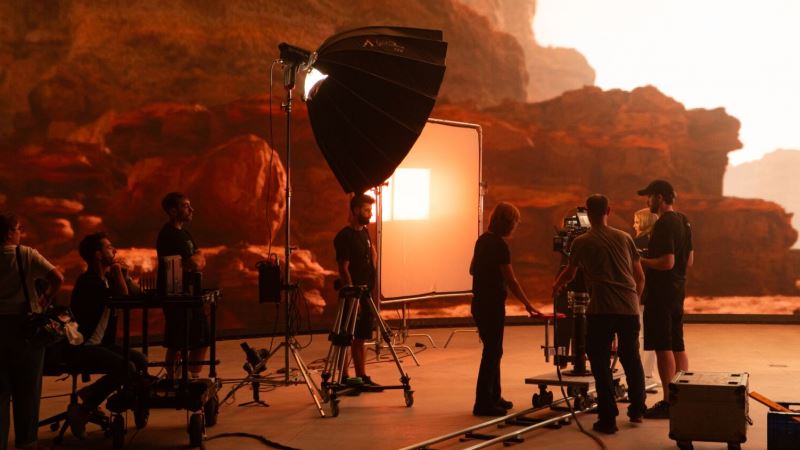
Europe’s Virtual Production Revolution: Inside Spain’s Coruña Immersive Studio
Hollywood’s secret weapon for cost-effective filmmaking just opened in Galicia
While the film industry debates the future of cinema, a quiet revolution is happening in Galicia, Spain. Coruña Immersive Studio, Europe’s largest virtual production facility, officially opened this week—and it’s about to change where and how movies get made.
What Makes Coruña Different?
Virtual production isn’t new. The Mandalorian proved its viability years ago, using massive LED walls to create photorealistic environments in real-time. But Coruña represents the democratization and globalization of this technology.
Here’s what sets it apart:
Scale: As Europe’s biggest dedicated virtual production hub, Coruña boasts LED wall arrays that rival any facility in Los Angeles or London. We’re talking massive, wraparound screens that can display anything from alien planets to medieval castles with pixel-perfect accuracy.
AI Integration: Beyond standard LED technology, Coruña incorporates AI-assisted tools that can generate and adjust environments on the fly, reducing pre-production time and giving directors unprecedented creative flexibility during shooting.
Cost Efficiency: This is the game-changer. By shooting in Spain with favorable tax incentives and lower operational costs compared to Hollywood, productions can achieve blockbuster visuals at a fraction of the typical budget.
European Positioning: For decades, American productions shooting in Europe meant logistical headaches. Coruña centralizes cutting-edge technology in a region with skilled crews, good weather, and government support.
View this post on Instagram
The Mandalorian Effect Goes Global
When Disney used virtual production for The Mandalorian, it wasn’t just a technical achievement—it was a proof of concept that has reshaped industry thinking.
Traditional filmmaking required:
- Expensive location shoots with massive crews
- Weather-dependent exterior photography
- Months of post-production for visual effects
- Limited ability to adjust creative choices after filming
Virtual production collapses these pain points. Directors can shoot in controlled environments while seeing final-quality backgrounds in real-time. If the sunset isn’t hitting right? Adjust it on the spot. Need to change a background building? Done in minutes, not months.
Coruña takes this model and adds a European twist: lower costs, strong government incentives, and access to international talent pools.
Hollywood Comes to Galicia
The studio’s opening week has already attracted attention from indie directors testing the waters for future blockbusters. While specific projects remain under NDA, industry insiders report that several major productions are in talks to utilize the facility.
Why are filmmakers excited?
Budget Stretching: A $50 million production can look like $100 million when virtual production is used effectively. For indie filmmakers working with limited resources, this is revolutionary.
Creative Control: Directors who’ve used virtual production describe it as “having the entire post-production toolkit available during principal photography.” The ability to make creative decisions in real-time, rather than hoping everything comes together in editing, is incredibly powerful.
Environmental Benefits: Fewer location shoots mean reduced carbon footprints from travel and transportation. While Hollywood talks about sustainability, virtual production offers concrete solutions.
Talent Attraction: Spain already has world-class cinematographers, production designers, and technical crews. Coruña gives them access to technology previously concentrated in Los Angeles and London, potentially sparking a creative brain gain.
The Technology Behind the Magic
For the film nerds (you know who you are), here’s what Coruña is working with:
LED Volume Stages: Massive walls of high-resolution LED panels that display photorealistic 3D environments with proper parallax and perspective shifts as cameras move.
Real-Time Rendering Engines: Powered by Unreal Engine and similar tools, these systems generate movie-quality graphics instantly, allowing directors to see final shots during filming.
Motion Tracking: Advanced camera tracking ensures that as cameras move through physical space, the virtual environment responds with perfect perspective alignment—maintaining the illusion of reality.
AI-Enhanced Background Generation: This is where Coruña differentiates itself. Proprietary AI tools can generate environment variations, suggest lighting setups, and even predict how different weather conditions would affect shots.
Color Grading Integration: The system accounts for how LED light interacts with actors and practical sets, meaning less color correction in post-production.
What This Means for the Industry
Coruña isn’t just a facility—it’s a signal that the film production landscape is shifting.
Decentralization of Hollywood: For a century, major film production has centered around Los Angeles (with London as a European alternative). As virtual production technology spreads globally, that monopoly weakens. Why shoot in LA when you can achieve the same results in Spain at lower cost?
Rise of Regional Hubs: Expect more cities to invest in virtual production infrastructure. It’s economic development policy disguised as entertainment infrastructure—bringing high-paying jobs and international investment to regions that have never been film production centers.
Indie Renaissance: When technology that was once exclusive to Marvel movies becomes accessible to indie filmmakers, creative possibilities explode. We’re likely to see a wave of visually ambitious independent films that would have been impossible to produce five years ago.
Hybrid Workflows: The future probably isn’t “all virtual” or “all practical”—it’s strategic combination. Smart filmmakers will use virtual production where it makes sense (sci-fi environments, period settings, weather control) while still shooting practical locations for intimate scenes and documentary realism.
The First Projects
While Coruña is keeping client details confidential, they’ve confirmed that the studio’s first film project is slated to shoot this October. Early indications suggest it’s a mid-budget sci-fi production from a European director with Hollywood ambitions—exactly the kind of project that benefits most from virtual production’s cost-to-quality ratio.
Industry watchers expect that if the first few productions go smoothly, Coruña will quickly book up for 2026 and beyond. The facility has the infrastructure to support multiple simultaneous shoots, meaning it could become a true production hub rather than a one-off novelty.
Challenges Ahead
Not everything is perfect in virtual production paradise:
Learning Curve: Crews need specialized training. Traditional cinematographers and gaffers must adapt to working with LED environments rather than natural light and practical locations.
Creative Overreliance: There’s a risk that filmmakers lean too heavily on virtual production as a crutch, creating films that feel sterile or over-controlled. The technology should serve story, not replace it.
Uncanny Valley: Despite technological advances, virtual backgrounds can still feel “off” if not executed perfectly. The gap between good and great virtual production is wider than people realize.
Market Saturation: As more facilities open globally, the competitive advantage diminishes. Coruña needs to stay ahead on technology and cost-effectiveness to maintain relevance.
The Bottom Line: Hollywood’s New Frontier
The opening of Coruña Immersive Studio represents more than just another production facility. It’s a referendum on the future of filmmaking itself—a future that’s less centralized, more technologically sophisticated, and potentially more accessible to diverse voices.
For audiences, the promise is better-looking films at every budget level. For filmmakers, it’s unprecedented creative control and budget efficiency. For Spain, it’s positioning as a major player in global entertainment production.
We’re watching the future of cinema being built in real-time, one LED panel at a time. And it’s happening in Galicia.
The revolution will be virtually produced.
Interested in virtual production technology? Follow our coverage as we track Coruña’s first projects and the global expansion of immersive filmmaking tech.
Catch us for latest Bollywood News, Movies Reviews, New Movie Release , and Follow us on Instagram, Twitter, Facebook